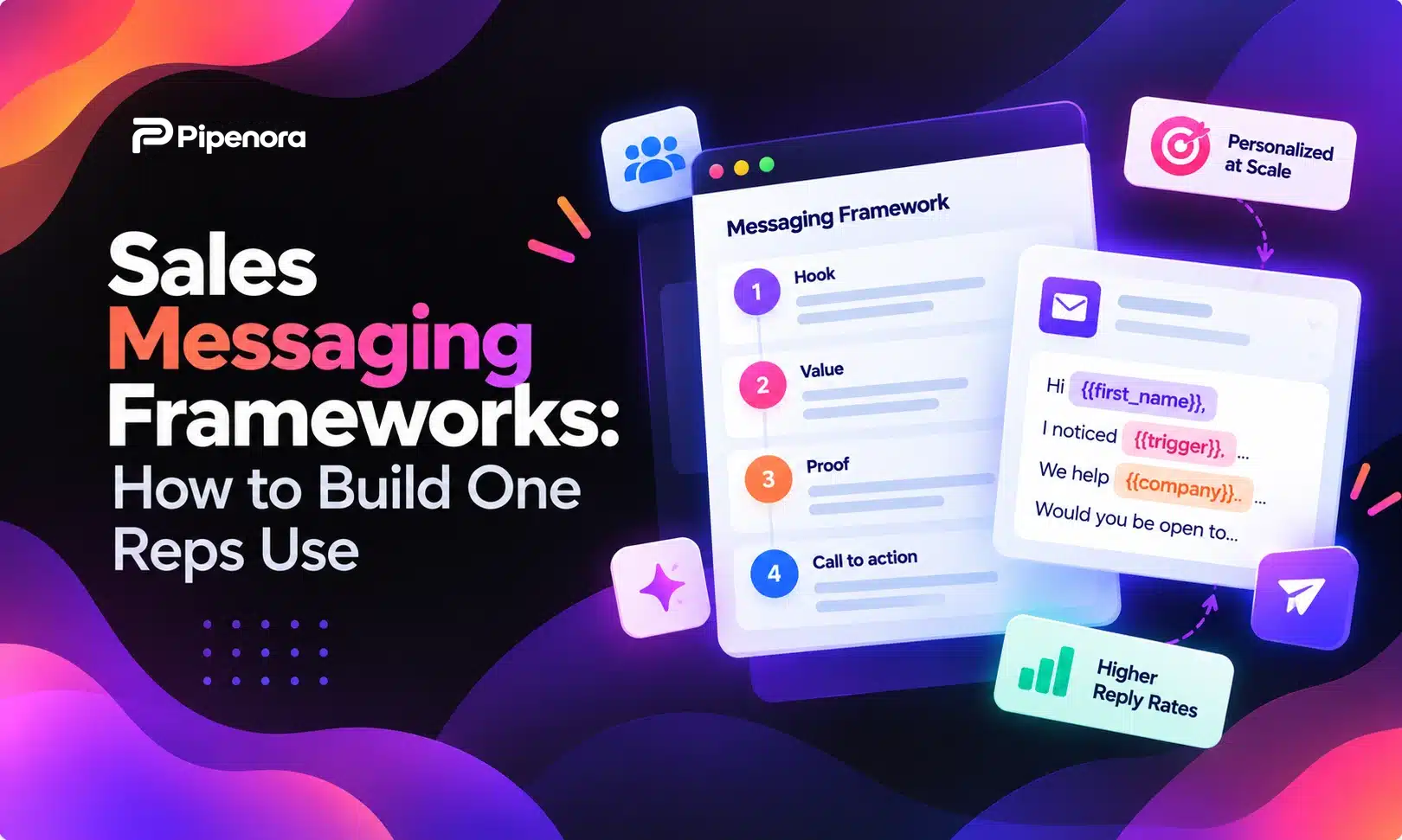
A sales messaging framework is an organized set of seller-ready messages that moves a specific buyer, or buying group, through a live opportunity. It is not your brand book and it is not a campaign brief. It turns your positioning into the words reps use in emails, LinkedIn messages, calls and proposals, adapted by role, industry and deal stage. This guide covers what belongs in one, how to build it from buyer evidence, how to write value proposition messaging for different roles, and how to keep the framework in use after launch.
TL;DR
- A sales messaging framework sits below brand and marketing messaging. It translates them into buyer-, role- and stage-specific conversations that a rep can use on Monday morning.
- The core parts are a primary message, a problem statement, three to four differentiated claims with proof, audience variants and objection responses.
- Build it from external evidence (customer interviews, win/loss analysis, call recordings), not from an internal workshop. Review it every six months or after a major product change.
- Keep the business outcome constant across a buying group. Change the question, the proof and the next step for each person.
- A framework only works if it lives inside the tools reps use every day, in sequences, templates and call prep.
Table of Contents
- What a sales messaging framework is, and what it is not
- The components every B2B sales framework needs
- Value proposition messaging: from features to a buyer’s stake
- How to build the framework, step by step
- Role-based examples: one outcome, different routes in
- Using the framework in outreach and live deals
- Perspective: a framework is an execution problem
- Putting the framework to work in Pipenora
- Keeping messaging current
- FAQ
- Sources
What a sales messaging framework is, and what it is not
Three layers are often mixed up.
- Brand messaging defines the broad company promise, positioning and voice.
- Marketing messaging speaks one-to-many to build awareness and demand.
- Sales messaging is the adaptive, one-to-one layer. It frames the problem, paints the outcome and supplies proof that fits the buyer in front of you. Its success is measured by concrete progress in the deal, not by impressions.
This three-way split follows Federico Presicci’s framework for scalable sales messaging. A 2018 MediaPost piece describes the same idea as one integrated system: brand messaging, product value propositions and persona messaging, plus modifiers for channel, context and journey stage.
In practice, the top-ranking pages for this topic are mostly written for product marketers and brand teams. They produce a tidy document: a positioning statement, pillars, a tagline. That is a useful input. It is not yet sales messaging, because a rep cannot paste a pillar into a reply to a skeptical VP of Operations. The gap between the launch deck and the live conversation is where most frameworks die.
The components every B2B sales framework needs
There is no single canonical template, but the credible ones converge on the same building blocks. Stratridge’s guide to building a messaging framework lists a primary message or value proposition, a problem statement, three to four differentiated claims with proof points, audience variants and objection responses. Nora Sudduth’s sales messaging breakdown gets more granular, with eight components: target persona, value proposition, pain points, differentiators, social proof, objection handling, key benefits and a call to action.
Combined into something a sales team can use, the framework looks like this:
| Component | The question it answers | What a rep needs from it |
|---|---|---|
| Primary message | Why should this buyer care at all? | One sentence, in buyer language |
| Problem statement | What is going wrong today, and what does it cost? | An opener for emails and discovery calls |
| Differentiated claims (3 to 4) | Why us, not the status quo or another approach? | Short claims, each tied to a proof point |
| Proof | Why should I believe you? | Customer outcomes, numbers, references by segment |
| Audience variants | How does this change for each role and industry? | Ready-to-adapt versions, not blank slates |
| Objection responses | What will they push back on? | Honest answers with evidence |
| Call to action | What is the next step? | A small, specific ask per stage |
The order matters. Bret Starr of The Starr Conspiracy argues that a framework should work as architecture, where positioning, audience, value and proof each feed the next layer, so nobody has to guess. If your proof points are not tied to a specific claim, reps will improvise, and improvisation is how messaging drifts.
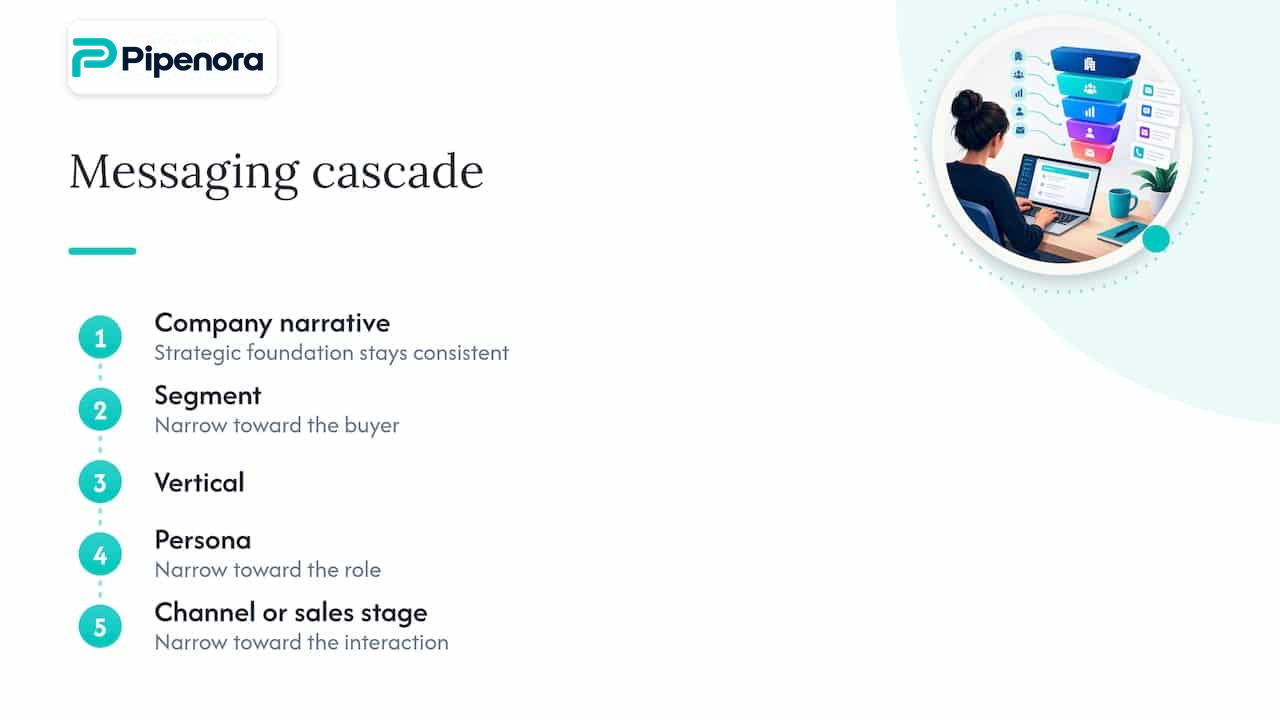
The layered cascade
A useful way to organize variants is a cascade. Start with the company narrative, then narrow to segment, vertical, persona and finally channel or sales stage. Presicci describes this cascade in the framework linked above. It keeps strategic consistency while narrowing to the buyer, the role and the interaction. A cold LinkedIn note to a RevOps manager at a Series B software company and a late-stage email to that company’s CFO share a narrative but almost no wording.
Value proposition messaging: from features to a buyer’s stake
Value proposition messaging is the part of the framework that says what changes for this buyer. Forrester’s portfolio marketing research calls for connecting functional needs with business and personal value across organizational, functional and individual dimensions, which is what creates a strong emotional connection. The same piece says leaders should focus on the whole buying group, not only the primary persona.
A four-part structure keeps this practical. RevCentric Partners’ value-based messaging guide connects the buyer’s business situation, the cost or consequence of inaction, the desired change and outcome, and the evidence plus the next decision. Here is how it reads when applied to a sales execution platform, as a template (the numbers are placeholders you would replace with your own verified figures):
- Situation: “Your reps work leads across a CRM, a data tool and three engagement tools, and signals arrive in none of them in time.”
- Cost of inaction: “Good accounts get contacted late or generically, and managers see the gap only in the forecast.”
- Desired change: “Reps act on the right accounts the same day, with messages that reference the trigger.”
- Evidence and next step: “Here is how a team of your size did it. Can we walk through your current sequence on a 20-minute call?”
Notice what is absent: a feature list. Features show up only as the mechanism behind the outcome.
How to build the framework, step by step
The research on this is consistent: start outside the building. Stratridge says effective frameworks rest on external market data, including customer interviews, win/loss analysis and discovery call recordings, to avoid internal echo chambers and to capture how buyers actually describe their problems.
- Collect buyer language. Interview recent customers and recent lost deals. Pull ten to twenty recorded discovery calls and highlight the exact phrases buyers use for the problem. Audit how alternatives are described on their pages and in their sales conversations, so your claims are truly differentiated.
- Define the components. Fill the table above for your core segment first. Resist covering every segment in version one.
- Draft three to five versions of the primary message. Write them in different framings: cost of the problem, speed, risk, control. Stratridge recommends testing these against buyer language rather than choosing by internal vote.
- Attach proof to every claim. A claim without a customer result, metric or reference is a hypothesis. Mark it as one.
- Build the variants. Create role versions (see the next section) and stage versions: first touch, follow-up, discovery, proposal, stalled deal.
- Load it into the workflow. This step decides adoption (more on it below).
- Review on a schedule. Stratridge suggests every six months or after a significant product change, adding proof points from new customer wins as they arrive.
The payoff for using buyer insight is worth knowing. Forrester reports that clients who applied buyer insights in sales enablement shortened sales cycles by two to three months and saw a 20 percent increase in pipeline value. That is one vendor’s client set, not a promise for your team, but it points the right way: insight before wording.
If your personas are thin, fix that before drafting. A guide to creating buyer personas for targeted marketing is a good place to sharpen the audience layer first. Forrester also notes that synthetic personas can pressure-test value propositions, surface likely objections and refine messaging before it reaches the market. Treat that as a pre-screen, then confirm with real buyers.
Role-based examples: one outcome, different routes in
The same product reaches a buying group through different concerns. A messaging matrix published by Abmatic gives sample pairings: ROI and payback for a CFO, security and compliance for an IT director, implementation burden for a VP of Operations, and adoption and usability for a VP of Demand Generation. Each pairs a concern with a tailored message and a proof point.
Adapted to a sales execution platform, a matrix might look like this. Treat each cell as a prompt for your own evidence, not a claim to reuse:
| Role | Their concern | Message angle | Proof to attach |
|---|---|---|---|
| CRO or VP of Sales | Predictable pipeline, rep productivity | Fewer missed signals, more actions on priority accounts | A customer result in pipeline created per rep |
| RevOps manager | Data quality, tool sprawl | One layer that works with the existing CRM, no rip-and-replace | Integration list, a data hygiene before and after |
| SDR or BDR manager | Rep ramp, reply rates | Personalized first lines at volume, built from real triggers | Sample sequences and reply data |
| Finance | Cost per seat and per credit | Transparent per-seat pricing and usage credits | Plan page and a cost-per-meeting calculation |
| IT or security | Access, data handling | What data is touched, where, and how permissions work | Security documentation |
RevCentric’s guidance is the guardrail here: keep the business outcome stable across the buying group and adapt the question, proof and requested next step to each person’s responsibility. Role-specific messaging should be a relevant route into one buyer-validated case, not an unrelated value proposition. If your CFO email and your RevOps email promise different things, the committee will notice when they compare notes.
Using the framework in outreach and live deals
A framework is judged by what reps do with it. Three habits separate the ones that get used.
Lead with the buyer’s problem, not your brand voice
In outbound, buyers respond to a message that names a specific problem they currently have. That is the point Nick Verity, CEO of Cleverly, makes in his guide to B2B messaging frameworks, and it matches what most SDR managers see in their reply data. Your problem statement from the framework is the first line. The brand narrative can wait for the landing page.
Teach something in the conversation
Gartner’s research on the Challenger model finds that the winning sellers differentiate through the sales experience itself, by disrupting the buyer’s thinking and teaching new insights. It also finds that a sense-making approach, where reps help customers prioritize sources and reconcile contradictory information, raises buyer confidence and the odds of a low-regret, high-quality deal. In messaging terms: include one insight per stage, such as a pattern you see across customers, that reframes the problem. Pure benefit statements do not do this.
Match the message to the channel and the timing
The cascade ends at channel and stage, so build the variants that way. A LinkedIn connection note needs one sentence and no pitch. An email needs problem, proof and a small ask. A call opener needs a question. For channel mix and sequencing, see our multichannel outreach playbook and the notes on timing in multichannel strategies. If your team sells socially, the social selling guide for B2B SaaS startups covers how to carry the same message into LinkedIn.
Forrester also stresses that portfolio marketing should partner with sales enablement on a repeatable knowledge transfer process to close the sales knowledge gap. In plain terms, marketing writes it, enablement teaches it, and managers inspect it in call reviews. Our sales enablement guide goes deeper on that handoff, and AI tools for sales coaching shows how to check whether reps use the approved language.
Perspective: a framework is an execution problem
We see the same failure pattern again and again. The messaging is good. It is approved, it is beautifully formatted, and it sits in a shared folder while reps write their own emails from memory. The cause is rarely rep discipline. It is that the framework lives in a different place from the work.
Our view is that messaging should be executed, not just documented. That means the problem statements and proof points live inside sequences, the trigger that starts a sequence decides which variant a rep or an AI agent sends, and the result flows back into the CRM so that you can see which message moves deals. When the buying signal, the enrichment data, the message and the channel sit in one flow, personalization stops being a manual step that gets skipped on a busy Thursday.
We also think AI should draft inside the framework, not around it. An AI agent given your problem statements, claims and approved proof will produce on-message variants at volume. An agent given a blank prompt will produce fluent, generic copy that sounds like everyone else’s. The framework is the constraint that makes the automation worth trusting.
Finally, treat messages as hypotheses. Every sequence is a test of a claim. Keep what gets replies and meetings, retire what does not, and feed the winners back into the framework at your six-month review.
— Alex
Putting the framework to work in Pipenora
If your framework is finished and the problem is adoption, this is where Pipenora fits. Pipenora is a sales execution layer that connects your CRM and sales tools, so buying signals, enrichment, AI-driven personalization and multichannel outreach run in one workflow where people and AI agents work together. You load your approved messages once, and they drive sequences across LinkedIn, email and calls.
Plans are priced per seat: the Pro plan starts from €719.20 per month per seat and Ultra from €1759.20 per month per seat, with Enterprise available on request. AI and enrichment tasks use credits, and the Agentic Sales Engine starts at €799 per month; contact rachel@pipenora.com for additional tiers. See the pricing page for what each plan includes, or look at the Agents Hub if you want to run agents against your messaging. For a how-to on rollout, read our guide to deploying AI sales agents in B2B sales.
Keeping messaging current
Messaging decays as products change, competitors reposition and buyers adopt new language. A light maintenance routine is enough:
- Monthly: compare reply and meeting rates by message variant. Retire the bottom performer, test a new one.
- Quarterly: listen to a sample of calls and check whether buyers repeat your problem language back to you. If they do not, rewrite the opener.
- Every six months, or after a significant product change: review the whole framework and add proof points from recent wins.
- After lost deals: add the objection and the best response to the framework, or note that no good response exists yet.
Synthetic personas can speed up step one of that loop, since they let you stress-test a draft before it reaches real buyers, but they do not replace live results. The pipeline is the final judge. Our guides on pipeline inspection and B2B sales orchestration show how to connect message performance to stage conversion.
FAQ
What is the difference between a messaging framework and a value proposition?
A value proposition is one element inside the framework. It states the primary value for a defined buyer. The framework adds the problem statement, differentiated claims, proof, audience variants and objection responses, so the value proposition can be adapted by role and stage without losing consistency.
How many messages should a sales messaging framework contain?
Start small: one primary message, three to four differentiated claims and variants for your two or three most important roles. Drafting three to five versions of the primary message is a sensible testing range. Add segments and stages only once the first set produces results.
Who should own the framework, marketing or sales?
Both, with clear roles. Product marketing or the revenue leader writes the foundation, and sales enablement turns it into training and templates. Reps and managers supply the buyer language and objections from live calls. Without the sales input, the framework drifts into internal language.
How often should we update it?
Review it at least every six months, and sooner after a significant product change. Between reviews, adjust individual variants based on reply and meeting data.
Sources
- Sales Messaging That Scales (with AI): Strategy & Framework
- Messaging Frameworks: Learn To Speak Their Language (MediaPost)
- How to Build a Messaging Framework (Stratridge)
- Sales Messaging: Strategy, Framework, & Components
- B2B Messaging Framework Template That Actually Works (The Starr Conspiracy)
- Six Key Areas That Should Drive Portfolio Marketing’s Agenda (Forrester)
- Value-Based Messaging: A Practical Guide (RevCentric Partners)
- Fueling the Revenue Engine With Buyer Insights (Forrester)
- The Real Promise Of Synthetic Personas Is Better Activation (Forrester)
- B2B Personalization Messaging Matrix (Abmatic)
- The Power of the Challenger Sales Model (Gartner)
- How to create buyer personas for targeted marketing success
